Sunday, July 8, 2018

The Newberry Medals: #1 The Story of Mankind by Hendrik Willem Van Loon

I wonder how many other people have done what I am proposing for myself: read the entire list of Newberry Medal winners in chronological order, from 1922 to the present. I may be alone in the non-editor, unpaid, unheralded category of readers. I do not even belong to the under 18 set of the target audience. So if anyone ever reads this blog, they may find their time slightly recompensed by the fact that I present a unique, if not keenly intellectual perspective. 

I don't pretend to be a literary critic or have a knowledgeable background from which to frame my opinions. I am just an ordinary reader, slightly attention-deficit, who, once upon a time was a poor reader, who over time and with practice has taught herself to first enjoy, then crave, then feast on the written word. I have begun where my interest waned in my youth: with children's literature. One day my brain will come of age and I may be able to read more of the McCulloughs and Hillenbrandts of the literary world. This project: to read the award-winning books written for my children's brains is in part an effort to grow out of them.

That is not to say I don't enjoy children's literature. On the contrary, I think the Children's category of literature is some of the most pleasurable to be found. No foul language or sexual minefields to navigate. Highly imaginative and full of attention grabbing sequences. Simple wording, yet figurative enough to train a mind to find alternate meanings and deeper understanding than what is literally written. So I set out on this reader's journey, excited to follow each hero's journey hoping to grow right along with them.

The first Newberry Medal winner was selected in 1922. I assume, but have no data to back it up, that the Newberry Medal might have been invented just to give honor to this impressive work. The title is The Story of Mankind by Hendrik Willem Van Loon. It tells the story, in the opinion and understanding of the author, of the history of the world in a style friendly to children in a 592 page nutshell.

My copy, which I ordered from Thriftbooks.com, is the 1984 reprint of the original with a 90 page addition written by Hendrik's grandson Willem.  Hendrik's portion was better than Willem's. In fairness to Willem, his portion was from 1927 to 1984, and for him, those were current events. It is much easier to give a non-biased evaluation of  the distant past than the recent past. But Willem's part was so very liberally biased that I had a hard time pressing through to the end. I wish I had simply stopped reading at the end of the original publication. I did enjoy the explanation of World War II but the work went downhill from there.

On the other hand, the original publication by Hendrik went uphill. I could see Hendrik growing as an author. Near the beginning, the continual and incessant use of the passive voice was distracting and confusing. But at the end, after 6 years of writing and research, his use of figurative language animated the text and I thought to myself, "This man can write."

The book narrates the history of the known world, from the point of view of a midwestern-born white Christian as he understood it from research and tradition. The facts and dates are ubiquitous, but not overwhelming, as I easily caught the "gist" of most all chapters. There are 76 chapters in this illustrated text, so none but a couple are so long as to require a mid-chapter bookmark. After reading it, I can say without a doubt, I understand the history of Mankind markedly better than ever before, even as a Magna Cum Laude graduate from a State University in the field of Education.

I recommend this book to anyone who would like a not-too-simplified, but approachable narration of the past, with the caveats that bias is unavoidable, style evolves and illustrations do not always illuminate.

Sunday, January 7, 2018

Family History Friday: Dad Was a Singer Too.

My Dad, a world renowned Immunologist loved Science, Cars and Baseball. He also loved to sing as a hobby. As he got older he always wanted us children to sing with him, but we would not always take the time. He eventually recorded 2 albums of his favorite songs just for posterity. My favorite of his was Edelwiess from The Sound of Music. I always thought he sounded a lot like Christopher Plummer. What do you think?

#52ancestors


Monday, January 23, 2017

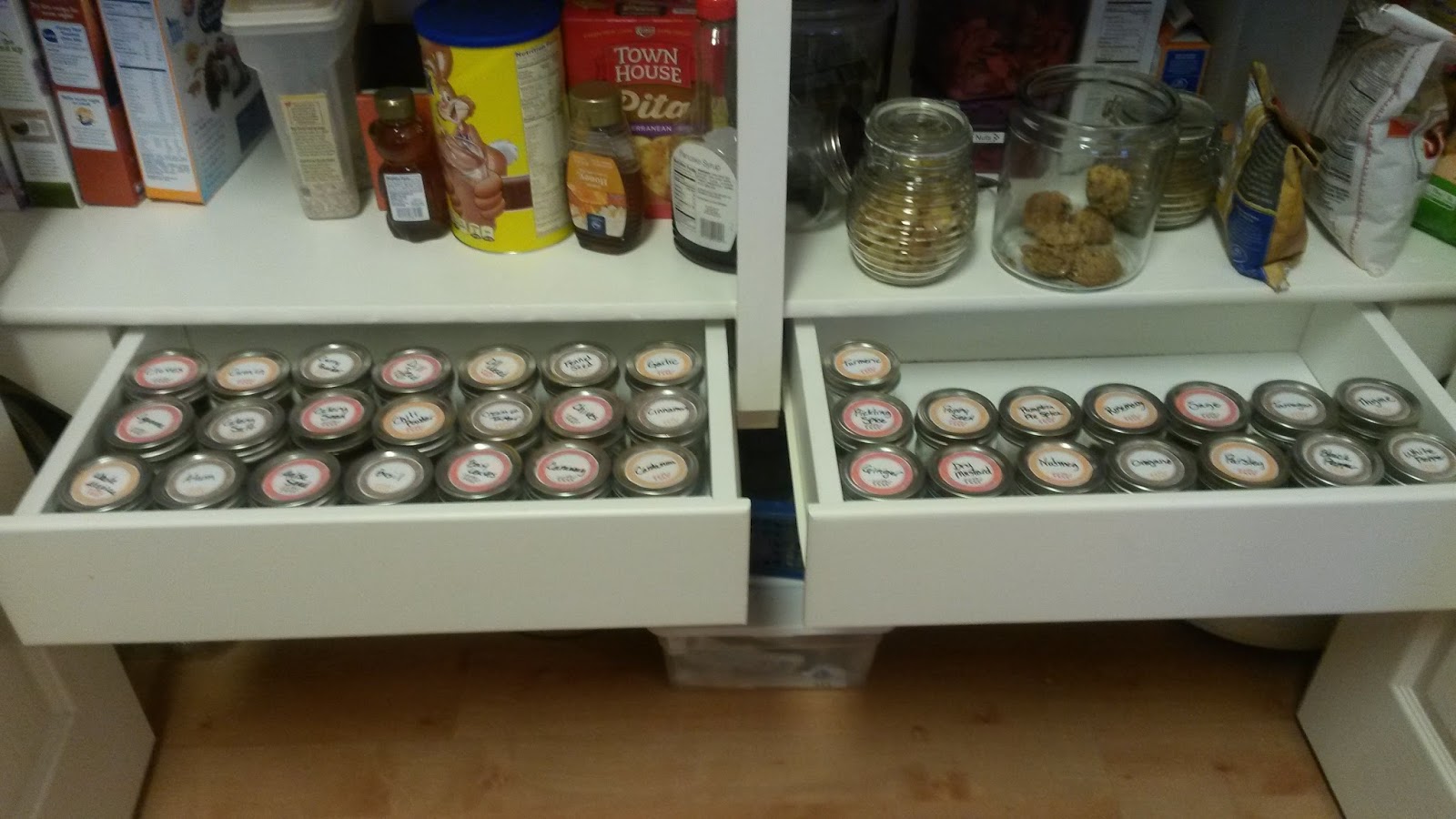
Make it Monday: Pantry Spice Drawers

Storing herbs and spices is tricky. They require darkness to maintain their potency, so dusty, counter-top spice racks are out. They're small, so tall cupboard space would be inefficient. A drawer would be a better idea, but all my drawers are filled with essential tools and linens. That leaves the pantry, but I hate to take up valuable real-estate with small, random sized bottles that are easily disorganized.

So, one day I had a brainstorm. I have an ordinary 5 foot wide pantry with bi-fold doors. The white painted shelves are sturdy, but made of inexpensive particle board. My brainstorm combined with hubby's mad carpentry skills converted scrap particle board from our garage into spice drawers built under the bottom shelves of the pantry.


I re-bottled all of my herbs and spices into half-pint canning jars so they would be easily organized. I labeled their tops and put them all in alphabetical order. My collection is quite complete, but there is room for more.


When gathering ingredients from the pantry, I can easily get the herbs and spices I need at the same time.


This project has solved the long standing problem of spice storage in my kitchen. Maybe it will provide inspiration for your kitchen storage problems too. 

Friday, July 1, 2016

The Fruit Leather Lay-Away Plan: 

a simple way to reduce waste, and ensure tasty, nutritious fruit leather 


When freezing berries throughout the summer months, I always have a few smallish, irregular or slightly soft berries that are better used in fruit leather. Also, from my berry plants I glean berries a little today and a little tomorrow, just enough to eat and to freeze a quart or two at a time. When I have odd lots of berries or seasonal fruit, I pack them in a freezer bag and label it "Berries for Leather".


As the season progresses, we go through harvests of strawberries, currants, gooseberries, raspberries, blackberries, peaches, and pears from our garden. I supplement with market bought fruit as needed for storage, and there are always soft (not rotten) fruits and small amounts of leftovers from the canning or freezing process. I throw them in the same baggie until it is full and I then start another one.

Finally in September when the apples are ready, I make applesauce with my imperfect apples. Then I thaw the contents of the "Berries for Leather" bag, puree' it and stir it into my applesauce. I usually have about 3 times as much applesauce as other mixed fruit. I use 12 cups of fruit puree' to fill 8 dehydrator trays. Your dehydrator will be different. I use the Nesco Professional Food and Jerky Dehydrator with 12" trays with the fruit leather liners installed. On each tray I use 1 1/2 cups of puree'. This makes a nice, just-right thickness, which has a great chewiness without being sticky or brittle.

BTW, the reason I have 8 trays is because after 16 years of faithful service, my old Nesco fan died. I bought a new dehydrator with identical trays, saved the old ones and stacked my dehydrator higher, allowing me to dry more at a time.


Tuesday, August 19, 2014

Christmas Village Stocking Holder

It's August, the kids are back in school and it's time to start thinking about Christmas, right? Ahem, just getting around to posting this from last year...

I love to decorate with houses. They remind me of my Main Thing. I have 2 "house" quilts, miniature resin houses here and there, cross-stitched houses, patriotic houses in my Americana basement, and a ceramic Christmas Village painted over the course of a decade by me, my DH and my 2 DD's.

Problem #1: I lacked a way to hang stockings from my mantel without damaging the wood, so last year I decided I wanted "house" stocking holders and went online to find a do-able project or an affordable purchase. No luck.

Problem #2: My house has no place to set up a 17 piece Christmas Village.

The conjunction of these two problems at once led me to this solution: Make Stocking Holders out of our favorite Christmas Village Houses.

This project turned out to be one of my Best Ideas Ever, and this is how I did it: and I did it only with materials I had on hand. It was, at the time of construction, free to me.  Yayah!

First I unpacked the Christmas Village.


 There are about 17 pieces all created to make a Bedford Falls scene complete with


Martini's Place, Gower's Soda Fountain and Drug Store, The Emporium, The Movie House showing It's a Wonderful Life, 

The Library,

The Bailey Building and Loan,

The School, The Church, The Movie House the Train Station and The Bedford Falls homes


This one is 320 Sycamore.

If you don't know what these buildings refer to, google "Bedford Falls" and then spend a few hours in remedial Iconic American Culture school. No offense but, good grief, how in the world???

I asked my DH to whip up a base for the stocking holder custom fit to my mantel. It included knobs from which to hang the stockings. The knobs were salvaged from a previous furniture re-hab.


I decided to make things complicated so I asked DH to create space under the board for the lighting wires. We have a TV above our fireplace complete with an electrical outlet, so "rigging up the lights" is a definite go.


Meanwhile, I asked each family member to choose a building from the Village Set to have above their stocking. We ended up with the Church, the Railroad Station, the Library and 3 random houses. I laid them out on the board with a few accessories: sign, trees, footbridge, gazebo and lamp posts.


I marked with pencil the position of each building and each lamp post so DH could drill the holes for the wires.


Then, I glued the houses in place. We first used hot glue. It shook loose easily, so we brought out JB Weld which will hold the houses in place FOREVER. 


I taped off the front of the board because it was stained and finished and I didn't want to paint over it. Then I painted the top of the board white...


...added textured snow, removed the tape and let it dry. 


I was sure to put plenty of snow on which covered all my accidental messes with deliberate messes. 

After it was dry, DH rigged up the lights. We lifted the board onto bar stools so he could work under it. 
I used a broom handle to support the center due to the now substantial weight of the piece. 


Then we set it in place on the mantel.  This stocking holder was able to easily support 6 filled stockings with no chance of tipping over. I love the way it looks all lit up!


And even though it looks like it, it does not block the view of the TV and we can enjoy our traditional viewing of  It's a Wonderful Life 

I displayed the remaining Christmas Village houses on our bookshelves with LED votive candles underneath each one. This Christmas I will take and post a picture of them. 

Tuesday, August 20, 2013

My Grocery Method: The Pantry Prinicple and Know The Store


My favorite grocery store just pulled a fast one! They actually had the nerve to move to a bigger place with a new and improved(?) store layout. Whether the layout is improved or not remains to be seen. However, no amount of whining on my part will, I'm sure, convince them to revert to the old arrangement. As a result, I find myself needing to update my Pantry List.

My Pantry List is a Word Document that lists all of the groceries I normally use to prepare our family's favorite meals. It's a list of staples and other necessaries that my pantry never wants to be without. When I sit down to plan my once-a-month "Big Shop",  I use one of these lists to help jog my memory. I simply go down the list, decide whether I need to stock up on each item and, if so, I circle the bullet mark in front of it. If I need more than one, I write a number next to the circle. I make sure to evaluate the status of everything on the list so nothing is forgotten. Then I'm set to shop with a list that I can rely on to be complete. I really have no patience for lazy, unreliable lists. 

The best part, though, is that I have taken the time to organize my Pantry List to match the aisles of my favorite store which always gets my Big Shop business (hence the need to also re-arrange the list). The products from each department are listed together so I only visit each part of the store one time. Even better, my pathway through the store follows my pathway down the list.  I start with produce, move to shelf stable and non-food items, saving cold, frozen and light, squish-able bakery items for last (they go on top of the pile in the cart).  I save time because I rarely need to backtrack; and, I save money because I can walk right to the items I need without hunting through tempting displays of things I don't need. The only drawback is that I can never plan on my grocery shopping to count as a workout.  This method just doesn't elevate my heart rate that much.

I always keep my pantry stocked with the ingredients to make plenty of our favorite meals.  So if I decide to change my mind about what's for dinner at 3:00 p.m. I don't have to run to the store, I just go shopping in the pantry.

Each week I still need to stock up on milk, bread, eggs, some produce and anything for a special occasion coming up, but I limit my staples purchases to once a month if possible. 

The most effective way to save money is to just not go to the store. Having a well-stocked pantry and an efficient list from which to work will keep your time in the store to a minimum.

You can take a look at my Pantry List below. It includes lists for both of the stores where I shop on Big Shop Day. Of course, you will want to build your own Pantry List based on the best stores in your town and your personal eating habits. So get to know your store.  Make note of where things are placed in it. Plan your shopping trip, shop your plan and get out of there as fast as you can.

http://www.mediafire.com/download/cuna3br0j6u2j48/Pantry_List.pdf

Thursday, July 11, 2013

Kids CAN Help In The Garden!


Newbie garden parents might be wary of trying to include their children in their new gardening adventure. If you are one of those, don't fret. Children have been helping their parents with this kind of work for longer than recorded history. They ARE capable, and they CAN learn to work (even if it seems hard) no matter what sob story they use to convince you otherwise. So what can children do to help in the garden? It all depends on their age:


What Can Kids Do To Help In The Garden?


Age 1-3: Their Help is Like No Help At All. They are really too young to be much help and they might actually be a hinder. These kids are sure to get very dirty, and are somewhat at risk of getting hurt. They need constant supervision if they are out in the garden. At this age, it's usually better to bring out a play tent and some toys or send them to an appropriate play area in your yard that you can see and monitor while you work.


If they are in the garden with you, these children can:

  • pick things up off the ground
  • eat a little dirt and build up antibodies (harmless in an organic garden. If a child eats a lot of dirt and will not stop, they probably are lacking in an essential nutrient in their diet.)
  • dump water from a tiny watering can
  • chase cats and birds away :)
  • "thin" seedlings either by trampling on them or pulling them up whether you wanted them pulled or not (such great helpers)


Seriously, my advice is find something else for them to do, or garden during nap time. While my youngest children were in this age group, I sometimes used 1 older child as a babysitter. Their whole gardening job that day was to keep the baby out of the dirt.


Age 4-7: The Passive Resistant Helper: works s-l-o-w-l-y or pretends it's just too hard for them. Whines. At this age, you are in training mode with your kids. Don't count on their help to be very productive. The point of having a child this young in the garden is to teach them how to do the work and teach them that they are expected to do it, that the yard work is not going away, that they have a job which nobody else is going to do for them and they must do it. Nip the lazy entitlement attitude in the bud. Plan for these kids to max out at about 20 minutes of work. Acknowledge their good effort and reward them with freedom.


These kids can:

  • rake
  • trowel
  • plant large seeds
  • weed with supervision
  • use a watering can
  • harvest by picking
  • snap beans
  • pod peas
  • get excited about bean teepees, raised bed mazes, eating fresh peas straight from the pod, hunting strawberries, riding in a wheelbarrow
  • get a ride in a wheelbarrow
  • roll pumpkins out of the garden


Age 8 to 15: really becoming a True Helper: starts out grumbling, but as he/she matures, accepts the work and just gets to it. Sometimes a kid this age even has fun with it. You can expect 30-60 minutes from these kids several times a week.


These kids can:

  • shovel
  • hoe
  • rake
  • trowel
  • plant all seeds
  • weed with instruction
  • drag a hose
  • use a watering can
  • harvest by picking or digging
  • snap beans
  • pod peas
  • stem strawberries
  • top carrots
  • corn "Chuck and Shuck"
  • give a little kid a ride in a wheelbarrow
  • help design the garden layout 
  • plant seedlings
  • tend their own planting bed from seed to harvest


Adult Jobs -16 and up and only after training: The Helpful Leader: knows how it's done, does a decent job and can help direct younger kids.


These people can:

  • Perform and supervise all of the above jobs
    Ferlilize
    Rototill
    Prune
    Use chemicals if necessary
    Use power equipment
    Drive a tractor


Congratulations, Mom and Dad! You have raised a competent gardener and passed this skill to a new generation.

Thursday, February 16, 2012

The Bathroom Rotation

The Bathroom Rotation: How to clean 3 bathrooms in 20 minutes

This idea sprouted from 2 needs: My need for clean bathrooms and my need to make my kids clean them for me. I would like to say that I had a benevolent feeling of preparing my kids for real life by teaching them the basics of bathroom cleaning but really it was just me needing a little help. In all fairness, though, the process of teaching any chore is, at the beginning, more work than actually doing the job alone. But, once child chore-mastery is gained, I feel sure my part in the process of cleaning bathrooms will get easier... surely... right? Well, it is getting better. S-l-o-w-l-y. In the words of Han Solo, "Short help's better than no help at all."

The Bathroom Rotation is a system that divides the work of cleaning the bathroom into stages. Each person (or team) is assigned a stage and is responsible to clean that portion of each bathroom in the house. For instance:

Team 1 is in charge of Prep and Sweep. This is the beginning stage of bathroom cleaning. Put everything away, clear off counters, shake and remove rugs, remove all items from the tub/shower area, empty the garbage, get everything off the floor and sweep away all hair, lint and dirt.

 Team 2 is in charge of Wet Cleaning: Clean the sink, tub and shower.

Team 3 is in charge of the Toilet room: Clean the toilet including the seat, base and the wall and floor surrounding it.

 Team 4 is in charge of Finishing: Clean mirrors, cabinet fronts, mop the floor and return removed items to their places.


Team 1 begins in the first bathroom. In my home it is the Master Bath. As Team 1 finishes in there, they call Team 2 to begin in the Master and Team 1 moves on to the next bathroom, and then the next. As each team finishes their first bathroom, they call the next team to begin. All teams will finish up at different times, but they will also start and different times. Working efficiently, each team will usually work for about the same amount of time.

 To make things easy, I printed and laminated a card for each stage. This card can be carried around with the team as they clean. On it is listed the steps in completing the assigned stage and the supplies needed to do the work. I have enough supplies on hand that no team needs to share with another. You can see my cards below; but your bathrooms are different and you will need to modify these or make your own.

Another option is to post a chart of stages and supplies in each bathroom eliminating the need to carry a card around as you go. My preference is the cards since I have some younger children for whom reading a complicated chart is overwhelming.

Each time we clean bathrooms, stages are rotated so everyone learns to do every job in the bathroom. I have a rotating chart in my cleaning closet and I store the work cards there as well.

Our family has been using this system for about 1 year. My children think it's as good as any other way to clean bathrooms, but I like it better. We rally together and we get the work done quickly. We now can clean all 3 bathrooms in 20-30 minutes on a good day. One hint for speed: We still have enough liberty in America that we don't have a toilet police. You need to face the fact that your bathrooms will only ever be sparkling clean if you do all the cleaning yourself. Don't expect perfection... even from your teenagers. Expect them to do their best, but don't harp on every little thing. You are on a team too and soon the rotation will come around to you and you can scrub each area until it shines if you want. Just remember that the whole reason for a bathroom rotation really isn't to get "short help." It's to lovingly train your children in the essential skills for life.

Friday, May 28, 2010

SQuIRRT


Summer Quality Intensive Reading Reward Technique :)

Keep your little squirrts reading this summer with this reward program:


I have no trouble getting our children to read during the summer. Each of our independent readers always has a book to read. They all read quickly and eagerly and when they are done, they look for another one. They go to bed with a book every night. After finishing a book, they often come to tell me about it and how much enjoyment they derived from the story. They read a variety of books. They read GOOD books. And, they use the books for inspiration to create original stories from their own heads. Reading is a joy at our house.

I am happy to say that our children are NOT natural-born-readers who come by this great habit by genetics alone. If they were, they would be such anomalies that scientists everywhere might request arrays of testing in cold, smelly labs to try to discover the “reading gene”. No. Our children are good readers because of habits formed through challenges and rewards provided by their parents. This is good news because that means YOU can do this with your OWN children.

Four summers ago I decided to incentivize our children's Summer reading with a points system (No, “incentivize” is not a real word; but, you get the idea; and, it sounds better than “bribe”). Creating a points system was easy enough. For each child I customized what they would each need to do to earn a point based on his/her own reading level. For example, at that time our oldest child could read well enough for me to require her to read 100 pages of a book to earn a point. Our second oldest was a reluctant reader, so I required of her only 30 pages for a point. Our youngest reader was in picture books so I awarded him 1 point for each book he read on his own.

So it looked like this:

Child #1: 1 point = 100 pages
Child #2: 1 point = 30 pages
Child #3: 1 point = 1 picture book

So far, so good. I had a measurable behavior clearly spelled out and customized for each child. Now, what could they cash-in their points for?

(This is the part I like best!)

Cool Back to School Supplies!

When you were a kid, didn't you always look at the rich girl in school with her sparkly rainbow folder or the boy with the Star Wars notebook, and then look down with derision at your peechee folder and 10 cent notebook? I did. So I thought our kids would work hard to earn the good stuff. I set it up like this:

5 points = 1 cool item
10 points = 2 cool items
15 points = 3 cool items
20 points = 4 cool items
20+ points = 4 cool items and a book or CD of their choice.

When I presented this plan to our kids, guess what? They LOVED it! All of them wanted to be the kid that had the nice school supplies! What's more is that I always wanted them to have the nice stuff, but I could never justify the expense. Now I had an excuse to splurge on them because they EARNED it!

At the end of the summer, most of our children had earned more than 20 points. We were very proud and excited. One child was overjoyed to get the BIG box of crayons with the built-in sharpener. Another child got mostly folders with cool pictures of bugs and aliens. I don't remember what our oldest picked out, but after she, a going-on 4th grader, read more than 2000 pages, I was glad to let her pick whatever she wanted.

Our plan has evolved over the last four summers. As each child grows, I increase the requirement to earn a point. Also, I began offering double points for choosing certain types of books. Last summer, I gave double points for the first of each genre they each read. i.e. the first biography, the first, historical fiction, the first non-fiction, etc. This year we will focus on the classics. I have a list of classic books appropriate to each reading level and will offer double points for reading them. You can find such a list here: http://www.amblesideonline.org/index2.shtml These are books that have stood the test of time, and are ennobling in nature for which I want my children to develop a taste.

I you have read to the bottom of this post, you must really want your children to read this summer. I encourage you to try this system. I can only say that it worked for our kids. You may have to adjust it using your parental instincts. Reading is a skill that is developed, not born. It will open for your children a world of fun and learning. Remember that the best way to learn to read is by example. So if you need an incentive to read, set one up for yourself along with your kids.

Saturday, April 24, 2010

Chives in my Kitchen Garden


It seems that chives are well-adapted to my area. I planted chives only once and they have come back each year without any help from me. One year I let the flowers get old and it self seeded in little clumps all over my quarter-circle kitchen garden. I thinned the clumps to 4. This year, those 4 clumps are bold and boisterous.

Unfortunately, chives are one of the few things I grow but never seem to use very much. I stare at the clumps and think that the monster-sized one probably ought to go. I shan't let him go to waste, though! No, no! Here is a recipe I am trying this year. If it tastes good, and I think it will, I will mass produce it for gifts.

Lemon-Chive Butter Log

Ingredients
1 Cup sweet cream UNSALTED butter, softened
7 T. fresh, snipped chives
2 T. Lemon Juice
1 T. Thyme, chopped, fresh (or 1 teaspoon dried)

Bring the butter to room temperature, then beat all ingredients together in a small bowl. Do NOT use a food processor. Form into a log inside a piece of wax paper. Twist the ends to seal. Refrigerate until firm, or freeze.

Use with all kinds of meat. I especially think this would be good with pork chops or steak.

Wednesday, April 21, 2010

For Parents: A lesson from a 2 year-old strawberry patch

Waking up the Strawberries
Along about the middle of March, or early Spring where you live, those hardy Strawberry plants will need a wake up call. Of course they will wake on their own, but without the following procedure, your strawberries will need to push through a thick blanket of dead leaves and vines remaining from the last year. This exercise will remove the majority of the flotsam, leaving the patch fairly open and free to enter full-scale photosynthesis. You will know your strawberries are ready to wake up when you see the first new green leaves emerge.

Choose a windy day for this. The wind at my house is always very accommodating in the spring. In fact, my neighborhood is the unofficial designated spring-training ground for wind. All of those hurricanes that cause havoc in the summer coastal regions got their first practice sessions right here in my backyard. I have found no better use for wind than to blow away unwanted garden debris. If you get a day with the right wind speed in the right direction, your debris may land right where you want it in your vegetable garden spot.

You also need a lawn rake (the flexible kind for raking leaves on grass) and a warm coat and gloves.

Go out to the strawberry patch and stand with the wind at your back. Take a minute to breathe the fresh spring air and reflect on the symbolism of the wind blowing you forward to a bright future. Okay, Enough. It’s too cold for that. Use your rake to gently brush the tops of the strawberry plants just enough that the dead leaves and vines begin to break free and blow away.

Now the strawberries are uncovered from their winter blankets and will happily begin to prepare cheerful white flowers and fat red berries. Help them along with some high nitrogen fertilizer to speed green up and build large leaves. Later in the spring give them a dose of high phosphorus fertilizer to encourage blooms and fruit!


A Spiritual Wake up Call
Strawberries are not the only creatures who need a wake up call. Believe me, I know the joy of dragging my own offspring out of bed on early school-day mornings... each and every morning of the year. It’s a thankless job. But have you ever considered that children need a wake up call not only for their bodies, but for their spirits too? Think about your family’s spirituality. Is your family awake with interest in spiritual things? Do they show love to each other and concern for the world around them? Can they serve others without thinking of rewards? Or are they self-centeredly, spiritually asleep? It may be time for a spiritual wake-up soon.

I have a friend whose husband takes each of their children in turn on a medical service trip to Peru in the summer. They work with their dad as he and his colleagues repair cleft lips and club feet. Those kids get to see first hand the realities of poverty that American kids are generally so insulated from. Her kids spiritually awaken to a new perspective which urges gratitude and prompts kindness.
An experience like this is “once-in-a-lifetime” for my friend’s children but “never-in-a-lifetime” for most of the rest of us. However, other, more simple and more frequent experiences can provide an equal spiritual wake-up call. The experience simply needs to force them to do these three “re’s”: re-think, re-evaluate and remember.

Re-think: the experience should startle them enough to get them out of their “I already know everything” mental state and consider the doubtful reality that they still have something to learn.

Re-evaluate: the experience should cause them to change what they think about their world, to count the blessings they are beginning to see were there all along.

Remember: the experience should bring them closer to God who is the source of all blessings.

Some other examples from my life include:
*My church sponsors occasional workshops for kids age 12-18 with music performances and humorous and inspiring speakers. These workshops present spiritual truths in a way that prompts those three “re’s” in teenagers. My kids come away with a new perspective and a new determination to live a moral and productive life. I have heard these workshops called “life-changing.” I agree. Each time these are offered, I encourage my kids to attend.

*I have read the “Little House” books to my daughters. Those books open their eyes to the way things used to be, the struggles and privation of the people who laid the foundation of our nation. The stories would never persuade them to give up their Nintendo Wii, but maybe they are a little more grateful as their Mario leaves Luigi in the dust.

*My husband and I have taken the time to drive our children to see historical places that are significant to our family. The children realize that the way things are today are not the only way things have been done and not necessarily even the best way.

*While on vacation we always try to visit places that are significant to our religion be it historical homes or churches or temples. The children get the idea that worshiping God is a common practice, a tradition that we should honor.

*It is our dream to someday visit the birthplaces of freedom in America with our children. We want to show them where my ancestor lived in Plymouth Plantation, where my ancestor died at Bunker Hill, Independence Hall, the battlefields at Gettysburg, and at Vicksburg where my ancestor is buried; to see where my husband’s ancestor came through Ellis Island and historical and important monuments, buildings and artifacts that make up the historic district of Washington D.C. We hope a trip such as that will instill pride in their country and a resolve to never let go of the gift of freedom. Not for anything.

Is there a new book you could read to/with your kids? Is there a special place they need to see? Are they in touch with their ancestors? Brainstorm ways to startle your kids into waking up spiritually. Then make sure it happens.

Then stand by as the breezy Spirit of God carries away the deadening flotsam of worry, rejection and discouragement in their hearts so the brilliant Love of God may shine gently down. It will remind them of who they are and add to the vision of who they may become. Soon after, you will see blossoming kindness and the fruits of love and respect in your children.

Thursday, April 15, 2010

Opportunists

My brother came with his tractor last night and plowed up our vegetable spot. Not 10 minutes later, a dozen birds showed up to gather the upturned worms. Hmm. How did they know?

Here is my feeble attempt at a poem:

Opportunists

Is it the grind of the tractor

That alerts the suitors,

Or a perk aroma

Only birds can tell,

Of worms up-heaved

With fresh-plowed soil;

An awakening sound?

An arousing smell?

Either or not

The lover-birds come

To capture the prize

And please the brides

Wednesday, April 14, 2010

What Was Paradise?

I'm ready


My three oldest children with our mammoth cabbage, 2008

Quote of the day:

"What was Paradise?
But a garden, and orchard
of trees and herbs,
full of pleasure,
and nothing there but delights."

William Lawson

Monday, April 12, 2010

Making Jam the "Old" Way


Did you know that jam was not always so bad for you? Once upon a time, jam was a concentrated way to store fruit for later use. These days, if you haven't noticed, jam contains more sugar than fruit...with corresponding flavor.

Last summer I took my kids to the library for our weekly visit. (I have great success getting my kids to read in the summer, hence a weekly visit is required. But that's another post). While they search the fiction shelves, the foodie that I am (have you seen my picture) usually finds my way to the cookbooks. That day, I picked up this cookbook "Summer In A Jar: Making Pickles, Jams and More" by Andrea Chesman.

The author touts her book's uniqueness by the small recipe sizes for small pickings of produce. I agree that this is a great feature. Most of us have small gardens, tiny kitchens and miniscule blocks of time to devote to a task like canning.

I liked best, though, the low-sugar, natural pectin jam recipes. The pectin (the part of the jam that makes it jell) is derived from apples which are minced fine and added to all flavors of jam, then cooked until a jelling point is reached. The use of this natural pectin allows the jam to be made with a much lower addition of sugar. For instance, a box of name brand powdered pectin calls for 4 cups of sugar to 1 quart of strawberries (1/1 ratio) for freezer jam; and 7 cups of sugar to 2 quarts of strawberries (.8/1 ratio) for cooked jam. Andrea's old-fashioned recipe calls for 1 1/3 cups of HONEY, (great stuff) to 3 quarts of strawberries plus 4 apples (.07/1 ratio). It does take a bit more time to make this jam and you have to use a candy thermometer. This must be why manufacturers opt for the high-sugar varieties. Yet, using my time to make my family's lifestyle better and healthier is the very reason I am a stay-home Mom. I can make quality easier than I can buy quality.

Sometimes the old way is the better way. I can see our culture is rediscovering some of the old solutions and dusting off some of the old values that modern efficiency sometimes leaves out. If you're on board with that idea, you may like this book.

Tuesday, April 6, 2010

Waiting On The Garden


Today is April 6th. In other years, I would be planting peas by now. As it is, we have had snow for the last 3 days. The soil is soggy and cold and I will not be planting today. Mother Nature will send me her signal when it is time. I will know by her yellow “go” signal. As I have been told by wise gardeners before, “when the forsythia blooms, it's time to plant the peas.” No forsythias yet.
This reminds me of when I was a young college sophomore and I desperately wanted to find true love. I have always been the type of person who needs to commit to an exclusive relationship, longing for a soul-mate throughout my growing-up years. By my 20th birthday I figured I had waited long enough. I was so ready to find that one person to be connected to forever. Fortunately, I didn't have to wait long. The following summer I began dating my sweetheart and we were married a year later.
There is always something I am waiting for. Graduations, marriages, births, sending the first child to school, sending the last child to school, the start of the growing season, the end of it. My children measure their lives around the 4 cardinal holidays of Easter, 4th of July, Halloween and their polar star: Christmas. “How many days until my birthday, Mom”, they ask when it's still 11 months away. Do we spend too much time waiting and not enough doing? Maybe.
But, think of this. If we never had winter, when would we plan our gardens? If we didn't have to wait for babies to be born, how would we prepare? If we never struggled through a period of temptation or failure, why would we ever set goals?
And I am living now. I'm nurturing seedlings indoors so they will be ready to go out as soon as possible. My vegetable patch is “shovel ready”: all graphed out with a list of needed supplies. Also, I am nurturing my youngest child as he is preparing to go to Kindergarten next year. I'm cleaning my house and progressing on craft projects that necessarily must go on the shelf when the yard work begins.
Wait time is not “great” time, but it has a purpose. Soon enough, the skies will clear, the temps will warm, the winds will die (or not) and I will have a fresh blister in the bend of my thumb earned by creating all of those raised beds. Not long after that, I will hear from my youngest boy, “Mom, how many days until it snows?”

Strawberries


There are few things as ugly as a bare-root strawberry plant. Yet, if it is treated the right way, it has the potential to produce beautiful, juicy strawberries that will bring great delight to many eaters. Our lives can be like this strawberry plant. Though we may make ugly mistakes, through the atonement of Christ, we can become delightful and perfected. We can fulfill our potential and live with our Heavenly Father in His Celestial Kingdom.

Quote of the Day - Strawberries: "Doubtless God could have made a better berry, but doubtless God never did." William Butler